Health Care
Mueller analyzes the loss of rural pharmacies on local health care
Wednesday, October 17, 2018
Keith Mueller, professor of health management and policy, says that a spike in rural pharmacy closures in recent years often deprives small towns that have no practicing physicians of their only local health care professional.
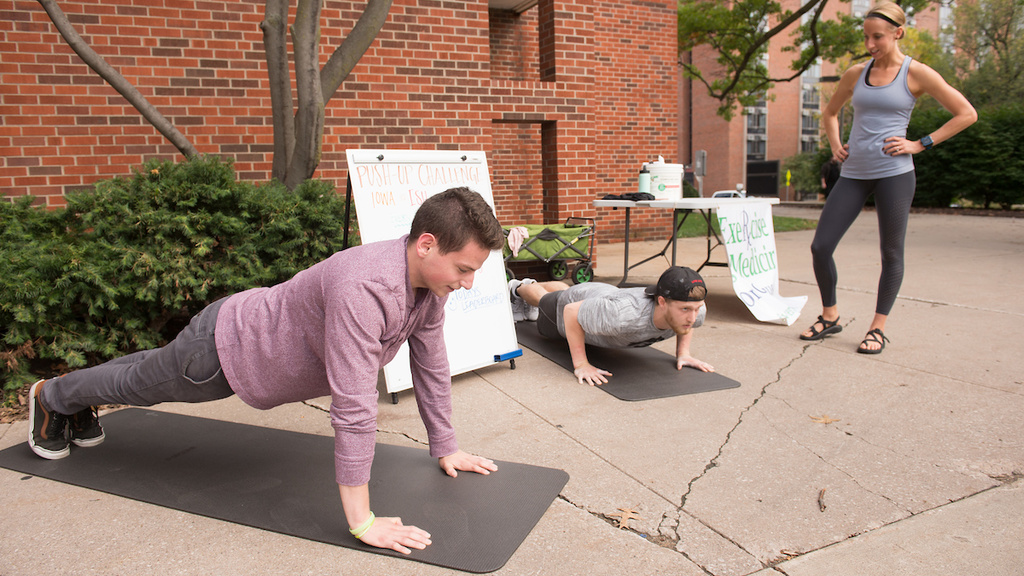
Exercise Is Medicine initiative seeks to promote physical activity as a vital sign
Tuesday, October 16, 2018
The Exercise Is Medicine initiative, launched by the American College of Sports Medicine and introduced to the UI campus this summer, calls for integrating physical activity into the health care setting. The Community Outreach Lab in the UI Field House is one endeavor related to the initiative.

University of Iowa surgeon Weigel named to National Academy of Medicine
Monday, October 15, 2018
Ronald J. Weigel, MD, PhD, MBA, the E.A. Crowell Jr. Professor and chairman of the Department of Surgery with University of Iowa Health Care, has been elected to the National Academy of Medicine (NAM), effective Oct. 1, 2018.

UI College of Nursing prepares next wave of modern health care leaders
Wednesday, October 10, 2018
The University of Iowa’s College of Nursing has long offered a rigorous nursing education that trains health care professionals who advocate for optimal patient care and outcomes, and who lead the way in health care research and innovation.
Researchers hope study leads to safer farm vehicles
Wednesday, October 10, 2018
A study from the College of Public Health finds that farm vehicle vibration can significantly contribute to chronic back and muscle pain in farmers who drive them, and researchers hope their study leads to design changes that make farm work less painful.
University of Iowa center receives CDC award renewal to continue expanding birth defect research
Wednesday, October 3, 2018
The Centers for Disease Control and Prevention (CDC) has renewed a $4.3 million grant to the University of Iowa College of Public Health for a project to identify factors in early pregnancy that may increase the risk of major structural birth defects.
UI played role in study that could help MS patients
Wednesday, September 26, 2018
A unit of the College of Public Health played a key role in a study by doctors at the Cleveland Clinic that finds a drug can be helpful in slowing brain atrophy in multiple sclerosis patients.

UI researchers identify marker in brain associated with aggression in children
Wednesday, September 26, 2018
A University of Iowa-led research team has identified a brain-wave marker associated with aggression in young children. The finding could lead to earlier identification of toddlers with aggressive tendencies before the behavior becomes more ingrained in adolescence. Results published in the Journal of Child Psychology and Psychiatry.

UI College of Public Health joins study to help reduce falls among elderly Iowans
Thursday, September 20, 2018
Injuries from falling cause a significant number of deaths among older Iowans, and the University of Iowa has partnered with a Des Moines–based subsidiary of Mercy Health Network on a project to reduce the number of falls.
UI Hospitals & Clinics earns Magnet Award
Wednesday, September 19, 2018
University of Iowa Hospitals & Clinics in Iowa City has again been re-designated as a Magnet hospital, the world’s top honors in excellence in nursing practice, UI Hospitals & Clinics leaders announced Sept. 19.

Multidisciplinary UI research team uses nanotechnology to create clot-less stent
Wednesday, September 19, 2018
Researchers in neuroscience, biomedical engineering, pharmaceutical sciences, and nanofabrication combined their expertise to create a clot-less stent to help people who suffer from brain aneurysms, which can cause massive hemorrhaging, stroke, and sometimes death.
Number of children diagnosed with ADHD jumps, according to UI research
Wednesday, September 12, 2018
The number of children diagnosed with ADHD has reached 10 percent in the United States, a significant increase over the past 20 years that is most pronounced in children from minority groups, according to a study from the UI College of Public Health.