
Simran Sarin has always been interested in how medicine is practiced in extreme environments, whether it be the remote Himalayas or outer space. Now, she will experience the fundamentals of medicine in space through a highly selective program sponsored by NASA.
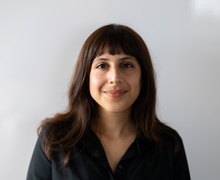
Sarin, a fourth-year medical student at the University of Iowa, is one of just 20 students nationwide accepted into NASA’s Aerospace Medicine Clerkship. During the four-week program that begins Oct. 5, she will attend expert talks on delivering medicine in space and be part of a student team that will conceive its own space-based medical research project.
“It's going to be really fun to be on the ground and getting a sense of what's going on, like how they organize and optimize the medical tools they need in space,” Sarin says.
Sarin learned about the NASA program almost accidentally. She was scrolling through her Instagram feed when a video promoting the clerkship popped up from an ophthalmology resident at the University of Southern California. At the time, Sarin had just immersed herself in learning about how astronauts’ vision can be affected in space. Despite her doubts that she’d be accepted, she applied.
“I didn't have much exposure to space medicine,” Sarin says. “But something about the opportunity and the ophthalmology connections related to it created this internal spark where I decided, ‘I need to know more.’”
Sarin says the clerkship will teach her about how basic bodily functions, such as vision, change when traveling from Earth to regions in space such as on the International Space Station, where humans experience very little gravity. She also hopes the clerkship deepens her interest in a recently discovered condition associated with space travel: spaceflight-associated neuro-ocular syndrome, or SANS.
Officially defined by NASA in 2011, SANS can occur when astronauts experience blurry vision likely caused by bodily fluids shifting upward in the body due to a lack of gravity. While SANS thus far has not led to permanent vision loss, the condition could be a threat during long-duration trips, such as a mission to Mars.
Sarin has been involved in SANS research since spring 2026, her third year of medical school, working with Edward Linton, assistant professor of ophthalmology and visual sciences at Iowa.
Linton’s SANS research focuses on the optic nerve, a cable that connects the eye to the brain, in patients with eye conditions similar to SANS, such as idiopathic intracranial hypertension, a condition that occurs when pressure rises around the brain.
The researchers hope that by examining these patients and applying machine learning models, or computer programs designed to recognize patterns in data, they can predict who is at risk of developing SANS.
“It’s a really great time to be involved with this kind of research,” Sarin says. “Part of why I like ophthalmology is there are so many unknowns. There’s novelty in space medicine, but there’s also novelty in everything else that we’re doing in this field.”
Sarin became interested in ophthalmology when she joined labs directed by Mark Greiner, professor of ophthalmology and visual sciences, and Christopher Sales. She immersed herself in research on the cornea, the outer surface of the eye that protects it from debris and focuses light.
Sarin studied the factors that lead to surgical errors in corneal transplants and Fuchs' endothelial corneal dystrophy, or FECD, a disease that causes the cornea to swell and become cloudy.
Sarin helped develop software called GuttEye, which analyzes FECD cells and helps them estimate the disease burden, or the total amount of harm it causes.
Her interest in how the eye adjusts to space was sparked by a paper centered around how spaceflight can affect the cornea.
“I remember reading one sentence that said, ‘We need to investigate the impact of lunar dust on the cornea,’ and I was like, ‘Oh. I never thought I would read a sentence like that,’” Sarin says.
Sarin received a bachelor’s degree from University of California-Berkeley, where she majored in precision health care and AI. She returned to Iowa City, where she was raised, for medical school to explore her growing interest in ophthalmology.
“I was tentatively interested in ophthalmology at the time, and it didn't hurt that Iowa’s ophthalmology program is one of the best in the world,” she said. “I was really excited to come back to Iowa.”
After the NASA clerkship, Sarin will continue to explore how doctors practice medicine in extreme environments by going on a rotation in the Himalayas in India and a separate Wilderness Medicine clerkship offered by the Carver College of Medicine.
Sarin says working in extreme environments is a necessary reminder of what it means to be a doctor.
“Challenging yourself to think through these scenarios allows you to become more creative and apply fundamental questions to patient care,” she says. “It helps you to be the best possible advocate for your patients.”