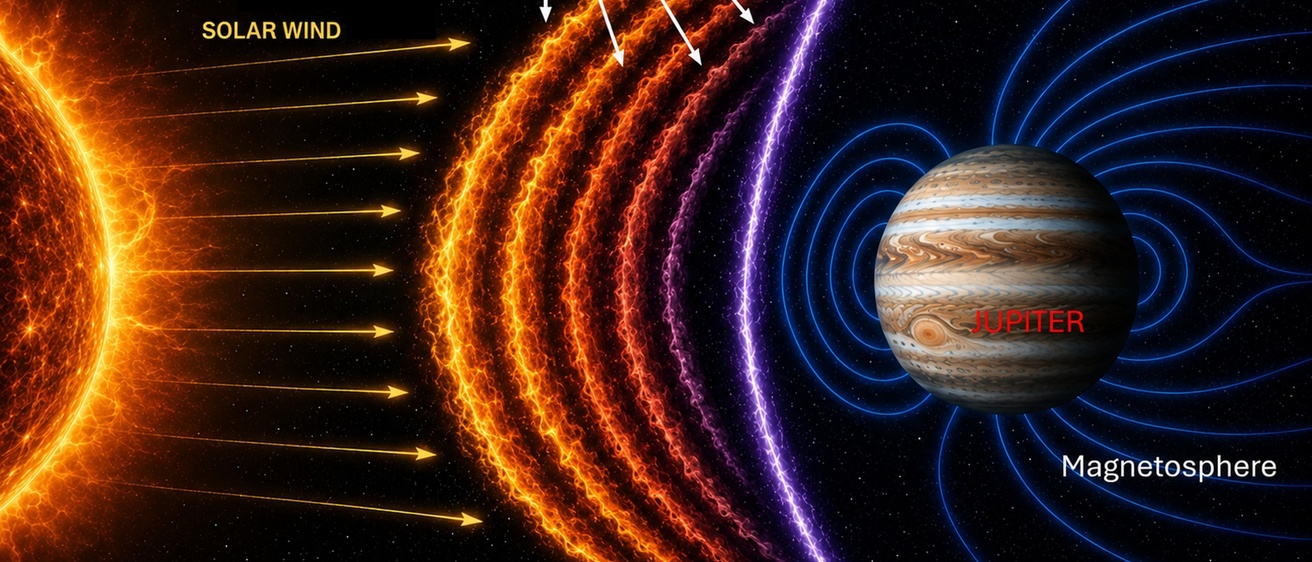
A University of Iowa-led research team in a new study has reported the most detailed observations to date of the bow shock at Jupiter, our solar system's gas giant. The findings, from NASA's Juno mission, reveal key differences in how the bow shock at Jupiter differs from that on Earth. It also may lead to better understanding into the physics of how shocks function in even more powerful energy releases, such as those from dying stars.
Why It Matters
Bow shocks are a fundamental process in physics. Supersonic aircraft generate shocks when they exceed the speed of sound, and supersonic solar winds generate shocks when they encounter planets. The bow shock on Earth provides one example, but Jupiter’s much stronger shock shows how these processes change under more extreme conditions. Some of the most energetic shocks in the universe are produced by dying stars, or supernovas, which can affect space and any life that may exist on other planets.
The bow shock is an invisible boundary situated between the sun and a planet’s magnetic field. It is the first line of defense against the supersonic burst of energetic particles from the sun known as the solar wind.
On Earth, the bow shock is important because it marks the point where the solar wind is slowed, heated, and then gets deflected around Earth. If that didn't happen, our planet would be bombarded by the solar wind and those harmful particles could reach our atmosphere and make Earth less safe for life.
Because Jupiter is a gaseous planet, scientists have been interested to understand how its bow shock physics differs from Earth’s and what it means for other planets and bodies in the universe.
In the study, the researchers found that Jupiter employs multiple frequencies of plasma waves, which they term “harmonics,” to counteract the solar wind’s strength. It’s like generating a richer note of music by playing multiple chords with one strum of the guitar; the more frequencies utilized by the plasma waves, the more effective it can be to absorb the solar wind’s impact at the bow shock. On Earth, plasma waves at the bow shock use mostly a single frequency, enough to deal with the solar wind.
“Jupiter has found its own way to deal with the solar wind, through plasma waves that are stronger and exhibit richer harmonic structures,” says Jayasri Joseph, a postdoctoral researcher in the Department of Physics and Astronomy at Iowa and the study’s corresponding author. “That’s important because if you have multiple frequencies, you can heat more particles in the solar wind and slow them down.”
The researchers found another difference between the two planets: Jupiter employs a series of regions, called shocklets, to engage with the solar wind and slow it down before it meets the planet's main bow shock. Earth, by contrast, keeps it simpler, employing its bow shock as the sole, main barrier.
“Earth does not need to take these extra steps to handle the solar wind because the impact isn’t as powerful,” says Bill Kurth, research scientist in the Department of Physics and Astronomy at Iowa and study co-author, who has been involved with the Juno mission since its launch in 2011.
The researchers say the bow shock physics at Jupiter could help explain how stars or other distant bodies handle the enormous volume of energy released by supernova remnants, the cataclysmic, final stages of a dying star.
“Because even more powerful shocks occur around astrophysical objects such as supernova remnants, Jupiter’s bow shock offers a nearby natural laboratory for exploring and for understanding how nature converts enormous amounts of flow energy into heat and energetic particles,” Joseph says.
The results come from data collected in December 2024 by the Juno spacecraft, which has been orbiting Jupiter since July 2016. Iowa physicists designed and built the Juno Waves instrument, which was key to collecting the data that led to the findings. Until Juno, no spacecraft had been able to adequately measure the complexity of plasma waves at the bow shock of an outer planet. Previous spacecraft had only detected the presence of the shock.
The study is titled “Plasma wave observations from Juno spacecraft at the Jovian bow shock.” It was published online on July 31 in the journal Nature Communications.
Contributing authors from the UI include Allison Jaynes, associate professor in the Department of Physics and Astronomy; and Jeremy Faden and Chris Piker, research support in the Department of Physics and Astronomy.
Other contributing authors are Lynn Wilson III, from NASA Goddard Space Flight Center; John Connerney, from NASA Goddard Space Flight Center and the Space Research Corporation; Frederic Allegrini, from the Southwest Research Institute and the University of Texas-San Antonio; Rob Wilson, from the University of Colorado-Boulder; Ali Sulaiman, from the University of Minnesota; Scott Boltion and Robert Ebert, from the Southwest Research Institute; and Barry Mauk, from Johns Hopkins University Applied Physics Laboratory.
NASA funded the research.