Why It Matters
The study shows it is possible to make terbium, a rare-earth metal used in electronics, medical imaging, and other technologies, easier and less expensive to separate and study. It also could open new areas of use, such as in quantum technologies, the unseen world of atoms and smaller constituents that could be a frontier for advances in computing.
Terbium may not be a household name, but the silvery-gray rare-earth element plays a role in many technologies people use every day. It produces the bright green glow in LED displays and the tiny pixels that help illuminate smartphone screens. It is also used in electric cars and fuel cells and makes X-rays safer.
Despite its importance, terbium, mined primarily in China but also found in the United States, is difficult to separate from other rare-earth elements. Scientists need specialized facilities and tightly controlled laboratory conditions, making the process expensive and limiting where it can be refined.
Now, there may be an easier way.
Chemists led by the University of Iowa in a new study report that they have separated terbium under non-lab conditions, an advance that could simplify how the element can be isolated and expand its use.

This study, led by Korey Carter, assistant professor in the UI Department of Chemistry, and Pere Miro, associate professor in the Department of Chemistry, could open terbium and other similar rare-earth metals for uses in quantum technology, the unseen world where atoms and other smaller constituents act in strange, hard-to-predict ways. Potential applications could be in computing and advanced sensors in navigation, medical imaging, and other fields.
To isolate terbium, the team sandwiched a terbium atom within a molecular structure made of metal and oxygen atoms. The structure stabilized the element in an uncommon oxidation state — a change in its electrons’ configuration that made it possible to isolate and study it in unprecedented detail.
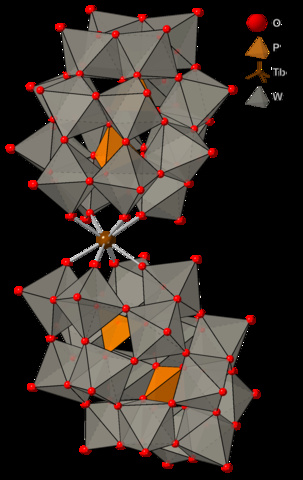
“One of challenges with lanthanides like terbium is they prefer to be in the same oxidation state, and it’s tricky to change that state and thus separate one from another without it being performed in a tightly controlled environment, such as a lab,” says Carter, the study’s co-corresponding author. “But we devised a method to isolate or separate terbium by changing its oxidation state in an environment that doesn’t require specialized lab controls.”
Moreover, Carter’s team isolated terbium in an environment that didn’t require special controls, such as temperature, humidity, or pressure.
“If you were in your house and you were setting up a chemistry experiment, it would be analogous to what we were doing in the lab,” Carter says.
His group now wants to take what they learned with separating terbium to investigating actinides, a group of highly radioactive elements used in cancer-fighting treatments and devices, such as powering cardiac pacemakers in the body and smoke detectors.
“Our findings highlight the ability to do transformative research at the University of Iowa, and they provide a platform to extend the chemistry to the actinide series in UI radiochemistry laboratories,” Carter says.
The study, “Structural and spectroscopic characterization of a Tb(IV) polyoxometalate,” was published July 16 in the journal Nature Communications.
Miro is a co-corresponding author on the study. Other co-corresponding authors are Benjamin Stein and Stosh Kozimor, from Los Alamos National Laboratory; and Jennifer Wacker, from Lawrence Berkeley National Laboratory.
Contributing authors are Primadi Subintoro, Brett Lottes, S. Genevieve Duggan, and Daniel Unruh, from Iowa; Felipe Pereiro, from Los Alamos and the Colorado School of Mines; Nolwenn Mahieu, Alexander Brown, and Joshua Woods, from Lawrence Berkeley; Monica Mullis, Aldo Jordan, Cassandra Gates, and Samuel Greer, from Los Alamos; Rebecca J. Abergel, from Lawrence Berkeley and the University of California-Berkeley; and Jenifer Shafer, from the Colorado School of Mines.
The research was funded by the U.S. Department of Energy.