A University of Iowa researcher has won funding from the U.S. National Science Foundation to develop a more accurate method to detect plasma waves’ involvement with high-energy particles that could endanger space travel, communications and passenger planes.
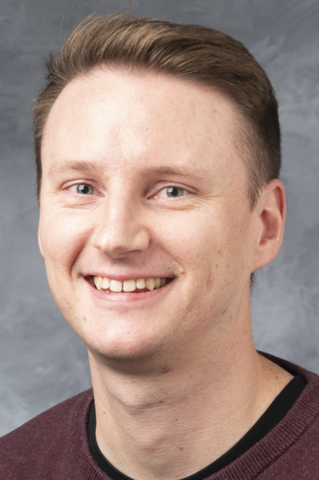
David Hartley, associate research scientist in the UI Department of Physics and Astronomy, has proposed a technique to more precisely measure one type of plasma wave, called a hiss wave.
Earth's magnetic field traps high-energy particles in large, donut-shaped rings called the Van Allen radiation belts, named after UI physicist James Van Allen, who discovered them in 1958. These high-energy particles act as radioactive landmines for spacecraft and astronauts passing through them; they can short circuit equipment and cause astronauts to experience radiation sickness.
They also can pose radiation risks to passenger jet travel. Forceful gusts of the solar wind can disturb plasma surrounding the Van Allen belts, creating plasma waves that ripple through the belt and expel the high-energy particles into Earth’s upper atmosphere.
Although scientists can determine high-energy particle concentrations at a single point in time, they cannot accurately simulate and predict those concentrations because they are unable to accurately measure the plasma waves that redirect them.
Hartley’s proposed method would focus on the electrical properties of hiss waves instead of relying on magnetic measurements, which are subject to background noise at low frequency.
Hartley hopes his method will improve forecasting of changes in radiation due to the movement and concentration of high-energy particles in and outside the Van Allen belts.
“Hiss wave properties are key to simulations of Earth’s radiation belts, which pose radiation risks for operational spacecraft, astronauts in near-Earth space, and both aircraft and passengers on polar-crossing routes,” he says. “This work will fill a known gap and improve the physical accuracy in predictive models of Earth’s radiation belts.”
The $143,000 award is for three years.