

For more than 50 years, the Wendell Johnson Speech and Hearing Center has been the site of pioneering communication sciences and disorders research on the University of Iowa campus.
Now, that work continues in a new location.
The UI Speech, Language, and Hearing Clinic — the new name of the center — and the Department of Communication Sciences and Disorders have relocated to the Health Sciences Academic Building. The Wendell Johnson Speech and Hearing Center building is scheduled for removal this summer as part of the university’s 10-year facilities master plan.
Additionally, the Health Sciences Academic Building at 302 S. Grand Ave. is home to the Department of Health, Sport, and Human Physiology and the exercise oncology clinic, as well as the Department of Physical Therapy and Rehabilitation Science. The central location for all the departments will provide a state-of-the-art learning environment for students, and encourage more collaboration as faculty, staff, and students work to serve people across the state of Iowa.
“This new building will have a great impact on people, communities, and the direction the department is moving,” says Eric Hunter, department executive officer for the Department of Communication Sciences and Disorders. “We’re thinking about the future and also are passing this baton to the next generation to continue the work and tradition that has gone on before us.”
Historic leaders in communication sciences
Iowa has been at the forefront of communication sciences research for more than a century, with faculty members Lee Edward Travis and Carl Seashore developing speech and hearing science as a discipline of study.
Seashore, head of the UI Department of Psychology and dean of the Graduate College, combined work in developmental psychology, psychiatry, otolaryngology, and pediatrics to form the new communication sciences field.
Travis became one of the first people in the world to receive a PhD in speech pathology in 1924 based on his studies in the communication sciences and disorders field. He went on to head the Iowa program through the 1930s.
Building upon that work, Wendell Johnson became a leading speech scientist when he joined the faculty at Iowa and was regarded as one of the founding figures in the field of speech-language pathology, including his research on stuttering.
Johnson graduated from Iowa with a Bachelor of Arts in 1928, a master’s degree in 1929, and a PhD in 1931. After completing his education, he taught semantics at Iowa — the first course offered under that title at any university — as well as a course on stuttering therapy and clinical practice. He went on to serve as director of the UI’s Speech Clinic and chief administrative officer of the Iowa Program in Speech Pathology.
“One of the big things he did was bring a real public eye to the work that was being done,” Hunter says. “He was just very vocal, having events and being in the public. He was able to be a voice, and I think it added a lot of prominence to the work being done at Iowa.”
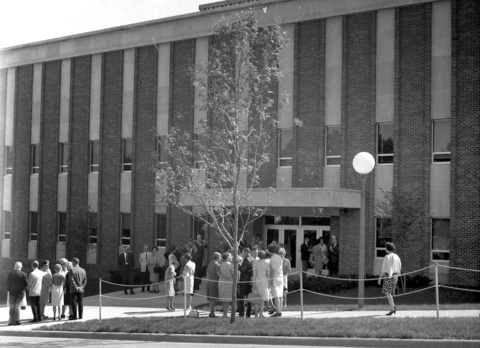
The Wendell Johnson Speech and Hearing Center was built in 1967. The new building led to growth in work in speech and hearing sciences, audiology, language disorders, cleft palate, neurogenic communication problems, and more.
The building’s crown jewel was its anechoic chamber, a type of soundproof room that created a pristine environment for audio research. Hunter says the UI was the first communication sciences department in the country to have one.
“So much happened here at Iowa with communication sciences research, and the building represented bringing it all together,” Hunter says. “The department had moved around a lot prior to the building’s construction, so it allowed everyone to come together under one roof so they could take their work to the next level.”
Continued excellence in new space
Iowa’s excellence in communication sciences, built upon by Johnson’s legacy, continues today.
Iowa holds a No. 2 ranking in audiology and a No. 3 ranking in speech-language pathology from U.S. News & World Report. Iowa also is home to the state’s only Doctor of Audiology program.
The University of Iowa Speech, Language, and Hearing Clinic — which has conducted more than 700 audiology visits and more than 1,400 speech-language visits over the past six months — provides comprehensive diagnostic and treatment services for children and adults with speech, language, voice, hearing, swallowing, and cognitive-communication disorders. Audiology services include diagnostic hearing evaluations, hearing aid and cochlear implant services, tinnitus management, and hearing protection, while speech-language services encompass evaluation and intervention.
With the move to the new Health Sciences Academic Building, the speech and hearing clinic will have greater capacity to serve more Iowans each year, as well as enhance student training to make an even greater impact in the coming years. Graduate student clinicians can learn from faculty members who are leaders in their field while gaining practical, hands-on training by caring for patients.
The new space includes modernized clinical areas, integrated technology, and greater access to interprofessional resources. There will also be unique spaces for both children and adults participating in research at the clinic.
The building also includes a behavioral observation lab, an acoustically isolated room with a large soundstage. Using motion capture systems and tuning the room’s acoustics, researchers will be able to emulate different scenarios, such as a person sitting alone in their home or shopping at a grocery store, to see how people interact in different spaces.
Hunter says the department is working on a display in the new clinic to recognize Wendell Johnson's legacy. Plans include a painting of Johnson working with a young boy, a selection of his words, and interpretive materials highlighting the history of the department and its enduring impact on the field.
“The new building is kind of a representation of what the old building was,” Hunter says. “The University of Iowa and Iowa as a state are very pragmatic. We’re always thinking about how to make things purposeful, and that culminated in how our department grew. The previous building was forward-thinking and cutting edge, but it was also practical, and that’s how the new building is, too. It’s going to be a gem for the university and the field.”