
Every year, more than 1 million visitors enter the quiet, reverent space inside the National Archives Rotunda in Washington, D.C., to see three of America’s founding documents: the Declaration of Independence, the U.S. Constitution, and the Bill of Rights.
Watch UI Center for the Book staff create archival paper
Want to see the Center for the Book papermaking process? Watch this video of staff creating the archival paper in 1999.
However, few realize as they peer through the protective glass that they’re also getting a glimpse of University of Iowa ingenuity. Each of these three treasured historical documents (known collectively as the Charters of Freedom) rests on a sheet of custom archival paper created by hand by papermaking specialists at the UI’s Center for the Book (UICB).
With the nation’s 250th anniversary approaching, UICB faculty shared how they were chosen to design and produce this specialized, acid-free paper built to last for centuries — a selection driven by the center’s long-standing reputation for excellence and innovation. Founded in 1986, UICB is a world-class center unique for its combination of craft practice (papermaking, bookbinding, calligraphy, and printing) and the study of the effect of books on society and culture.
“It’s so magical to have been part of that experience, knowing that the work we were doing was helping keep these vital documents safe,” says UICB director Sara Langworthy, who helped make the special acid-free archival paper as a graduate student in 1999. UICB paper has since been used in the conservation of other major historical documents, including the National Archives’ 729-year-old copy of the Magna Carta.
A call from the National Archives
The story of the UI’s involvement began in 1995, when conservators at the National Archives and Records Administration (NARA) discovered microscopic defects in the glass atop the helium-filled cases that had protected America’s three founding documents since 1951.
That discovery led NARA to launch a five-year, $5 million effort to replace the encasements. The project was part of a larger, $100 million effort to refurbish the National Rotunda, making it more accessible to the visitors who wait in line 364 days a year for a glimpse of history.
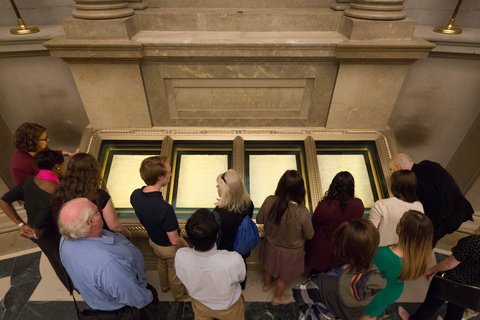
The Declaration of Independence and other documents were to be moved into airtight encasements with titanium frames, tempered glass that’s three-eighths of an inch thick, and sophisticated climate-control systems. Inside each was an aluminum platform perforated with thousands of small holes upon which each founding document would rest, held in place with tiny plastic clips. The holes allow humidified argon gas inside the chambers to circulate, protecting the documents from fading or becoming brittle.
Specialized paper was needed for three reasons: to help make the translucent parchment documents more legible for visitors, to provide a stable cushion, and to help regulate the conditions in each encasement (which are kept at 67 degrees Fahrenheit with a humidity level of about 45%).
Don Etherington, an internationally renowned pioneer in the world of conservation, led the encasement project. In an interview from his North Carolina home, Etherington, now 90, says one of his first meetings was with NARA experts who quickly dismissed his plans to use Japanese-style paper on which to rest the Charters.
“From that moment, I realized I needed Tim,” he says.
Then-UICB director Tim Barrett, a renowned papermaker with an encyclopedic knowledge of papermaking techniques who had won a MacArthur “genius” fellowship, had a suggestion when Etherington called. He’d been experimenting with making paper from American-grown textile cotton using 15th-century European methods.
Etherington was sold. Barrett and others at UICB were elated but quickly realized the gravity of the work ahead.
“I think all of us were initially like, wow, what an honor,” Barrett says. “That lasted about three minutes, and then we thought, ‘Holy smokes, we actually have to pull this off. We cannot make any mistakes; this has to be done right.’ The sense of responsibility quickly took over.”
Making paper
The UICB team on the project, including 10 UI students, faced two large challenges.
Creating sheets of paper far larger than they usually worked with (each page of the Declaration of Independence is about 24.5 inches by 29.75 inches) meant building custom equipment, including a 30-by-30-inch press with an 80-ton air bladder, and working in pairs or trios to handle the wide sheets it produced. The team also needed to ensure it provided a range of paper thicknesses that would allow the conservators to select the proper total mass for each document.
“These sheets are basically three times as large as what we normally might do, and we had to make sure it matched the thicknesses they required,” Langworthy says.
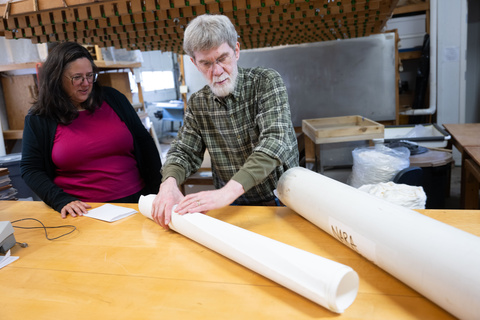
The painstaking work was done at the UI Oakdale Campus’ Paper Research and Production Facility — a low-slung, 2,500-square-foot building filled with a large array of papermaking tools.
The team began by selecting batches of high-quality, unbleached cotton, cooking it in lime and hard water, and using machines to beat it into pulp. Working in pairs, students dipped a large mold into a vat to form thin sheets, which were then pressed onto damp felt. Another layer of damp felt was placed on top, followed by another sheet of paper — a process that was repeated 12 to 15 times. The accumulated stack was then pressed to expel excess water, creating a single sheet of paper. Drying the oversized sheets required multiple people to handle them, with fans running continuously. The still-damp, oversized sheets were then carefully placed between pressurized blotters to dry, which took a day or two.
After two months, the team produced 25 sheets that met the strict specifications. Special cargo crates were built to ship them to the National Archives, where, after undergoing rigorous testing, the paper was placed under the Charter documents in their new encasements.
The leftover sheets were stored at the UICB Oakdale Campus Paper Facility, where they still look and feel brand-new. The UI-made paper now supports some of the most famous American documents, which have been on display in the remodeled Rotunda since 2003.
“Iowa helped preserve America’s founding documents, and really, at the end of the day, it’s because the people of the state of Iowa support the UI and make this kind of innovative research possible,” says Barrett. “That’s something they can be proud of.”