
The Iowa Board of Regents has approved a tuition increase for University of Iowa students to address effects of inflation and maintain the excellent quality of public higher education, research, and services.
At its April 23 meeting, the board approved a $287 increase to base tuition for undergraduate resident students and a $475 increase for undergraduate nonresident students. For graduate students, the approved tuition increase is $360 for resident students and $464 for nonresident students. The increases will take effect at the start of the fall 2026 semester.
“The University of Iowa remains one of the most accessible places to receive a high-quality education,” says Kevin Kregel, executive vice president and provost. “By thoughtfully investing in our campus, we are ensuring that the university remains a strong, competitive institution that delivers long-term value for our students, our state, and the communities we serve.”
Undergraduate resident tuition and fees at Iowa remain among the most affordable for students in the university’s peer group.
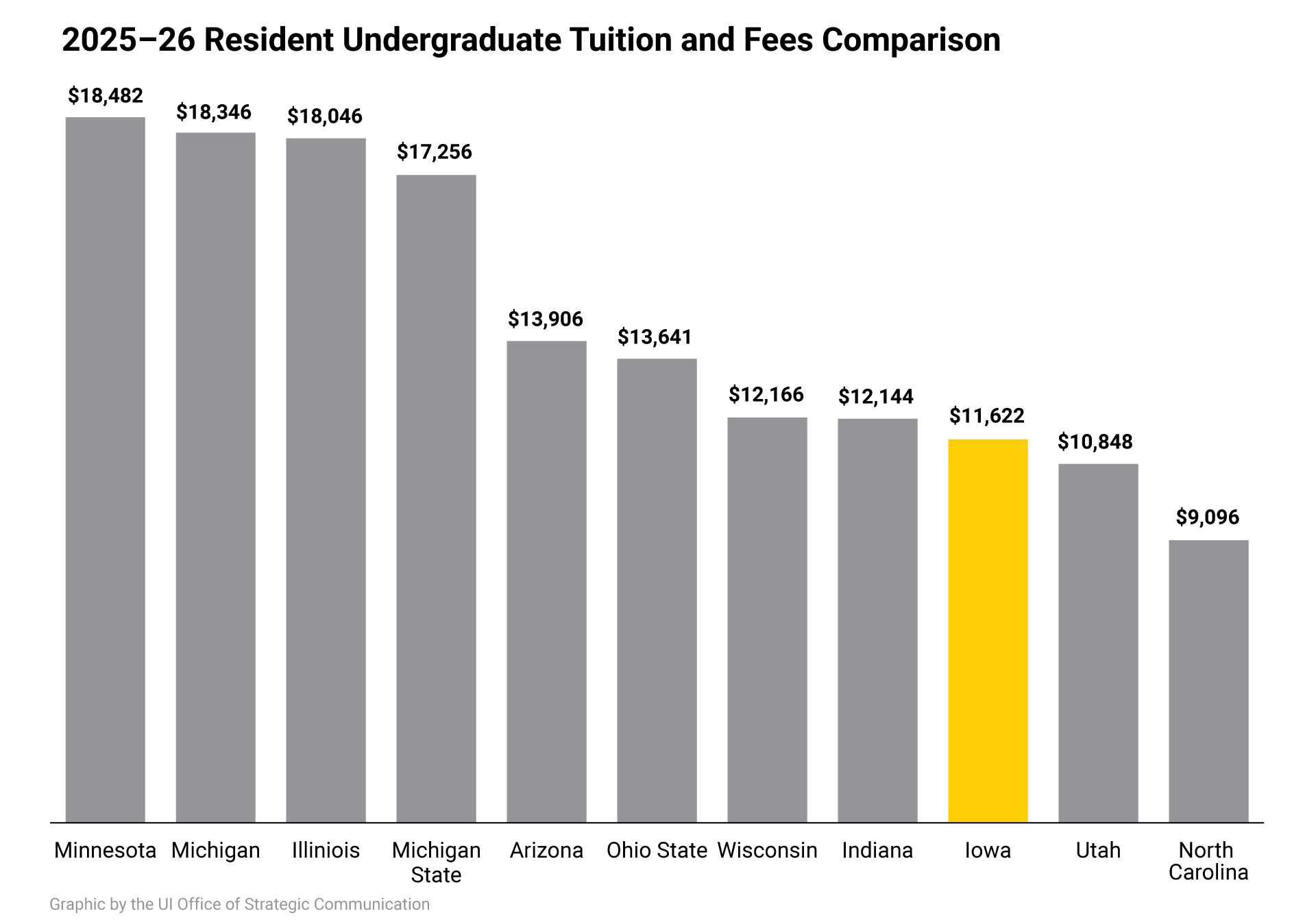
Certain undergraduate programs will see variances from the overall change in tuition:
- The Tippie College of Business will eliminate the system of different tuition rates for Bachelor of Business Administration (BBA) students based on completed college credits and have a base $13,052 tuition rate for resident students and a $35,328 tuition rate for nonresident students.
- To pay for additional services required for economics majors now that the undergraduate program has moved from the College of Liberal Arts and Sciences to the Tippie College of Business, new students in the major will have a tuition rate of $11,852 for resident students and $34,128 for nonresidents.
Some graduate and professional colleges will keep their tuition rates flat, while the board approved slightly higher increases for specific programs based on costs.
Tuition will not increase for nonresident students in the Carver College of Medicine’s Doctor of Physical Therapy and Master of Clinical Nutrition programs. Likewise, there will be no tuition increases for resident or nonresident students in the College of Public Health Master of Public Health program.
Tuition increases were approved for the following:
- Carver College of Medicine Doctor of Medicine (MD) program: 1.9% increase for nonresident students.
- Master of Science in Athletic Training, Carver College of Medicine: 2.4% increase for resident and nonresident students.
- College of Dentistry Advanced Standing Program: 1.9% increase for current students and a 2.8% increase for new students.
- College of Dentistry Doctor of Dental Surgery (DDS) program: 2.1% increase for nonresidents already enrolled. For students who enroll in fall 2026 or later, there will be a 4.5% increase for resident students and a 3.1% increase for nonresident students.
The board also approved a mandatory student fee increase of $62 for undergraduate students and $55 for graduate students. The extra funds will go toward technology, health and mental health services, student activities, modernizing student spaces, and recreation.
| Tuition and fees | Year and price increase | Undergraduate Resident | Undergraduate Nonresident | Graduate Resident | Graduate Nonresident |
|---|---|---|---|---|---|
| Base tuition | 2025-26 | $9,565 | $31,653 | $12,000 | $30,947 |
| 2026-27 | $9,852 | $32,128 | $12,360 | $31,411 | |
| $ increase | $287 | $475 | $360 | $464 | |
| Mandatory fees | 2025-26 | $2,057 | $2,057 | $1,829 | $1,829 |
| 2026-27 | $2,119 | $2,119 | $1,884 | $1,884 | |
| $ increase | $62 | $62 | $55 | $55 | |
| Tuition and mandatory fees | 2025-26 | $11,622 | $33,710 | $13,829 | $32,776 |
| 2026-27 | $11,971 | $34,247 | $14,244 | $33,295 | |
| $ increase | $349 | $537 | $415 | $519 |