NASA renames space mission to honor University of Iowa’s James Van Allen

NASA renames space mission to honor University of Iowa’s James Van Allen

Main Page Content

Van Allen Probes mission honors Van Allen, University of Iowa
1994 portrait of James Van AllenFile photo by Tom Jorgensen.

“What’s in a name?” asked Shakespeare.

Quite a bit, according to NASA.

On Nov. 9, NASA renamed a recently launched mission to study Earth's Van Allen radiation belts as the Van Allen Probes mission in honor of the late James A. Van Allen, U.S. space pioneer and longtime distinguished professor of physics in the University of Iowa College of Liberal Arts and Sciences.
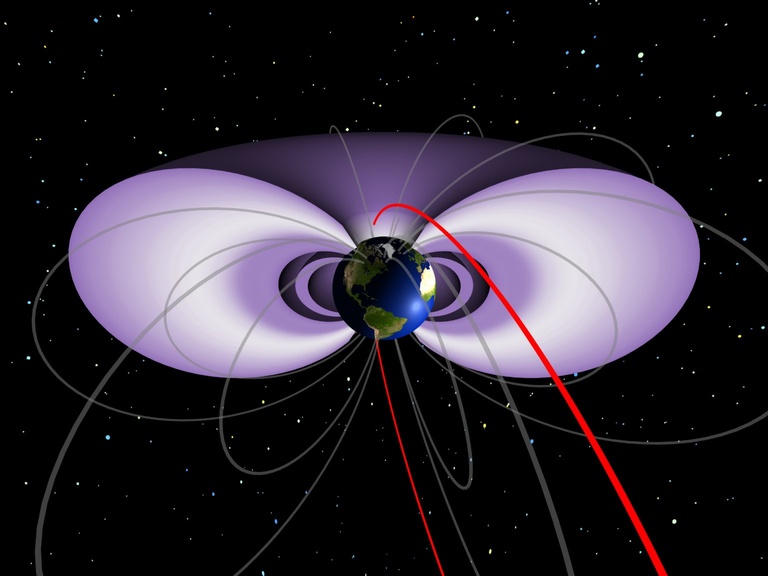
illustration of radiation belts
The Van Allen Probes mission is aimed at learning more about the Van Allen radiation belts—concentric, doughnut-shaped bands of intense radiation encircling the Earth.

Van Allen discovered the radiation belts, two concentric, doughnut-shaped bands of intense radiation encircling the Earth, in 1958 with instruments he and his UI colleagues designed and built. The instruments were carried aboard Explorer 1, the first successful U.S. satellite.

Renaming the mission makes good scientific and historic sense, says Craig Kletzing, the UI’s F. Wendell Miller professor of physics and astronomy and principal investigator for one of the five instrument suites on NASA’s Van Allen Probes mission.

“Professor Van Allen discovered the radiation belts at the beginning of the Space Age over 50 years ago. Today, there remains much to learn about how they work, how the sun delivers energy to the environment about the Earth, and how the interaction between the sun and the Earth creates these two bands of very energetic particles called the Van Allen radiation belts,” he says.

Solar storms and coronal mass ejections sometimes cause the belts to swell dramatically. When this occurs, the radiation belts can threaten communications, GPS satellites and human spaceflight activities.

Launched Aug. 30 from Cape Canaveral, the Van Allen Probes mission (formerly called Radiation Belt Storm Probes) consists of two satellites having slightly different orbits so that over time, one will travel ahead of the other. Orbiting the Earth from about 300 miles above the ground to as far as 25,000 at apogee, the satellites fly nearly identical orbits during their two-year mission.

The UI-designed-and-built EMFISIS (Electric and Magnetic Field Instrument Suite with Integrated Science) investigation is a $30 million NASA-funded project to study how various amounts of space radiation form and change during space storms.

Van Allen’s long and illustrious career found him serving as professor and chair of the UI Department of Physics and Astronomy from 1951 until his retirement from teaching in 1985. From 1985 until his death in 2006, he continued to conduct research, publish papers in professional journals, and counsel students.

His research highlights included his 1973 first-ever survey of the radiation belts of Jupiter using the Pioneer 10 spacecraft and the 1979 discovery and survey of Saturn’s radiation belts using data from the Pioneer 11 spacecraft. In all, he was principal investigator for scientific investigations on 24 Earth satellites and planetary missions.

His many awards included a NASA lifetime achievement award, membership in the National Academy of Sciences, the National Medal of Science, and the Crafoord Prize—for space exploration, the equivalent of the Nobel Prize—from the Royal Swedish Academy of Sciences.

The Van Allen Probes comprise the second mission in NASA's Living With a Star program to explore aspects of the connected sun-Earth system that directly affect life and society. The program is managed by NASA's Goddard Space Flight Center in Greenbelt, Md.

For more information about NASA's Van Allen Probes mission, visit: www.nasa.gov/vanallenprobes.

Contacts

Gary Galuzzo, University Communication and Marketing, 319-384-0009
Debug
Workflow
Workflow Status: 
Published
Workflow Notes: 
placed main art, inline art, Gary will provide caption information for the inline illustration of the radiation belts, SC 11/12 Caption updated, SC 11/12 replaced inline image per Gary, SC 11/12
Publication Schedule Notes: 
All, Except for finding an image of Van Allen or other art, this story should be ready to go. Gary
Workflow Schedule Bridge: 
0
Send Workflow Email: 
0
Images
Primary Image Caption: 
File photo by Tom Jorgensen.
Primary Image Alt Text: 
1994 portrait of James Van Allen
Thumbnail: 
1994 portrait of James Van Allen
Thumbnail Alt Text: 
1994 portrait of James Van Allen
Home Page Feature Optional Image (Horizontal): 
Home Page Feature Optional Image (Vertical): 
Home Page Feature Optional Image Caption: 
File photo by Tom Jorgensen.
Home Page Feature Optional Image Alt Text: 
1994 portrait of James Van Allen
Contact Wrapper
Contacts: 
Gary Galuzzo
Contact1 Department: 
University Communication and Marketing, 
Contact1 Phone: 
319-384-0009
Contact1 Email: 
gary-galluzzo@uiowa.edu
Home Page and Section
Publish as Home Page Feature: 
1
Preview as Home Page Feature: 
0
Home Page Feature - Category for Display: 
Research
Optional Home Page Feature Teaser: 
On Nov. 9, NASA renamed a recently launched mission to study Earth's Van Allen radiation belts as the Van Allen Probes mission in honor of the late James A. Van Allen, U.S. space pioneer and longtime distinguished professor of physics in the University of Iowa College of Liberal Arts and Sciences.
Publish as Home Page Picker Item: 
1
Preview as Home Page Picker Item: 
0
Home Page Picker - Category for Display: 
Research
Home Page Picker - Short Title: 
NASA honors Van Allen
Home Page Picker Teaser: 
Renames mission after space pioneer
Publish: Arts Section Feature: 
0
Publish: Athletics Section Feature: 
0
Publish: Campus Section Feature: 
0
Publish: Community Section Feature: 
0
Publish: Health Section Feature: 
0
Publish: Research Section Feature: 
0
Publish: AR2012 Section Feature: 
0
Preview: Arts Section Feature: 
0
Preview: Athletics Section Feature: 
0
Preview: Campus Section Feature: 
0
Preview: Health Section Feature: 
0
Preview: Community Section Feature: 
0
Preview: Research Section Feature: 
0
Preview: AR2012 Section Feature: 
0
Preview Section Feature Date Stamp: AR2012: 
Wednesday, December 31, 1969 - 6:01pm
Publish Section Feature Date Stamp: Research: 
Wednesday, December 31, 1969 - 6:01pm
Publish Section Feature Date Stamp: AR2012: 
Wednesday, December 31, 1969 - 6:01pm
Publish Section Date Stamp: Outreach: 
Wednesday, December 31, 1969 - 6:01pm
Publish Section Feature Date Stamp: Health: 
Wednesday, December 31, 1969 - 6:01pm
Publish Section Feature Date Stamp: Arts: 
Wednesday, December 31, 1969 - 6:01pm
Publish Section Feature Date Stamp: Campus: 
Wednesday, December 31, 1969 - 6:01pm
Publish Section Feature Date Stamp: Athletics: 
Wednesday, December 31, 1969 - 6:01pm
Preview Section Feature Date Stamp: Research: 
Wednesday, December 31, 1969 - 6:01pm
Publish Home Page Feature Date Stamp: 
Monday, November 12, 2012 - 11:14am
Preview Home Page Feature Date Stamp: 
Wednesday, December 31, 1969 - 6:01pm
Preview Section Feature Date Stamp: Athletics: 
Wednesday, December 31, 1969 - 6:01pm
Preview Section Feature Date Stamp: Campus: 
Wednesday, December 31, 1969 - 6:01pm
Preview Section Feature Date Stamp: Health: 
Wednesday, December 31, 1969 - 6:01pm
Preview Section Feature Date Stamp: Outreach: 
Wednesday, December 31, 1969 - 6:01pm
Preview Section Feature Date Stamp: Arts: 
Wednesday, December 31, 1969 - 6:01pm
Preview Home Page Picker Date Stamp: 
Wednesday, December 31, 1969 - 6:01pm
Publish Home Page Picker Date Stamp: 
Tuesday, November 13, 2012 - 10:17am
Hidden Fields
Hidden Beat Email Sent: 
0
Hidden Mail Sent: 
0
Hidden Video FIDs: 
Hidden Date First Published: 
Monday, November 12, 2012 - 11:13am
Hidden Date First Published Set: 
1
hiddent title for display: 
NASA renames space mission to honor University of Iowa’s James Van Allen
Story Type Display Name: 
Story
Unpublish?: 
0

Share:

Email Button

 Email