Enzyme triggers heart failure

Enzyme triggers heart failure

Main Page Content

Inhibiting CaMKII activity could lead to new heart disease therapies

University of Iowa researchers have previously shown that an enzyme called CaM kinase II plays a pivotal role in the death of heart cells following a heart attack or other conditions that damage or stress heart muscle. Loss of beating heart cells is generally permanent and leads to heart failure, a serious, debilitating condition that affects 5.8 million people in the United States.

Mark Anderson, MD
Mark Anderson, M.D., Ph.D.

Now the UI team, led by Mark Anderson, M.D., Ph.D., professor and head of internal medicine at the UI Carver College of Medicine, has honed in on how CaM kinase II triggers heart cell death following heart damage, showing that the action takes place in the cells’ energy-producing mitochondria. In animal tests, the team reports that blocking the enzyme can prevent heart cells from dying, and protects the animals from heart failure.

Mitochondrial are the cells’ batteries, generating the energy cells need to work. In heart cells, energy produced by these small cellular components fuels each heartbeat. However, when the heart is stressed, for example during a heart attack, the mitochondria become leaky and non-functional, which triggers cell death and heart failure.

Mei-ling Joiner, PhD
Mei-ling Joiner, Ph.D.

“We found that activity of the CaM kinase II enzyme in mitochondria promotes cell death when the heart is stressed,” says Mei-ling Joiner, Ph.D., UI assistant professor of internal medicine and lead author of the study, which was published online Oct. 10 in the journal Nature. “The findings might help us advance treatment of heart diseases and reduce mortality after a heart attack.”

The new study shows that activated CaM kinase II promotes leakiness of mitochondria and increases heart muscle damage by allowing too much calcium to enter mitochondria. Specifically, the UI team found that CaM kinase II regulates calcium entry into mitochondria by modifying a special mitochondrial calcium channel. Too much enzyme activity increased the amount of calcium flowing into mitochondria, and this calcium overload triggers cell death.

Using genetically modified mice, the team also showed that inhibiting CaM kinase II activity in mitochondria prevented the calcium overloading, reduced mitochondrial disruption, and protected the mice from heart cell death during heart attack.
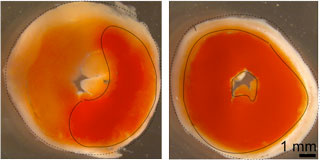
Heart slices stained with a marker of viability.
Inhibition of CaMKII enzyme protects heart muscle during heart stress. In heart tissue shown, deep red color indicates living heart muscle. More heart muscle survived in heart tissue on the right, where CaMKII enzyme was inhibited during heart stress.

These findings provide insight into molecular mechanisms for mitochondrial function and suggest that inhibiting the CaM kinase II enzyme in mitochondria could lead to new and more effective therapies for common forms of heart disease.

“Because mitochondria also play important roles in other diseases in brain and skeletal muscle, for example, our findings could also have broad implications for understanding and treating non-cardiac diseases,” says Anderson, who also is director of the UI Cardiovascular Research Center.

In addition to Joiner and Anderson, the research team included UI researchers Olha Koval; Jingdong Li; B. Julie He; Chantal Allamargot; Zhan Gao; Elizabeth Luczak; Duane Hall; Brian Fink; Biyi Chen; Jinying Yang; Steven Moore; Thomas Scholz; Stefan Strack; William Sivitz; and Long-Sheng Song, and Peter Mohler at Ohio State University.

The research was funded in part by grants from the American Heart Association, the National Heart, Lung and Blood Institute, the Fondation Leducq for the Alliance for CaMKII Signaling, and Pew Scholars Trust.

Contacts

Mark Anderson, Internal Medicine
Mei-ling Joiner, Internal Medicine
Jennifer Brown, UI Health Care Marketing and Communications, 319-356-7124
Debug
Workflow
Workflow Status: 
Published
Publication Schedule Notes: 
Published Thursday, Oct. 11 in the afternoon; please include in the digest Friday, Oct. 12 -- STEVE
Workflow Schedule Bridge: 
0
Send Workflow Email: 
1
Images
Thumbnail: 
Home Page Feature Optional Image (Horizontal): 
Home Page Feature Optional Image (Vertical): 
Contact Wrapper
Contacts: 
Mark Anderson
Contact1 Department: 
Internal Medicine, 
Contact1 Email: 
mark-e-anderson@uiowa.edu
Contact2 Name: 
Mei-ling Joiner
Contact2 Department: 
Internal Medicine, 
Contact2 Email: 
mei-ling-joiner@uiowa.edu
Contact3 Name: 
Jennifer Brown
Contact3 Department: 
UI Health Care Marketing and Communications, 
Contact3 Phone: 
319-356-7124
Contact3 Email: 
jennifer-l-brown@uiowa.edu
Home Page and Section
Publish as Home Page Feature: 
0
Preview as Home Page Feature: 
0
Optional Home Page Feature Teaser: 
A University of Iowa study shows that CaM kinase II enzyme triggers heart cell death by making the cells’ energy-producing mitochondria leaky. Inhibiting the enzyme in mitochondria protected mice from heart cell death during heart attack and other forms of heart stress. The findings could lead to better therapies for common forms of heart disease.
Publish as Home Page Picker Item: 
1
Preview as Home Page Picker Item: 
0
Home Page Picker - Category for Display: 
Research
Home Page Picker - Short Title: 
Enzyme triggers heart failure
Home Page Picker Teaser: 
UI study could lead to new heart disease therapies
Publish: Arts Section Feature: 
0
Publish: Athletics Section Feature: 
0
Publish: Campus Section Feature: 
0
Publish: Community Section Feature: 
0
Publish: Health Section Feature: 
0
Publish: Research Section Feature: 
0
Preview: Arts Section Feature: 
0
Preview: Athletics Section Feature: 
0
Preview: Campus Section Feature: 
0
Preview: Health Section Feature: 
0
Preview: Community Section Feature: 
0
Preview: Research Section Feature: 
0
Publish Section Feature Date Stamp: Research: 
Wednesday, December 31, 1969 - 6:01pm
Publish Section Date Stamp: Outreach: 
Wednesday, December 31, 1969 - 6:01pm
Publish Section Feature Date Stamp: Health: 
Wednesday, December 31, 1969 - 6:01pm
Publish Section Feature Date Stamp: Arts: 
Wednesday, December 31, 1969 - 6:01pm
Publish Section Feature Date Stamp: Campus: 
Wednesday, December 31, 1969 - 6:01pm
Publish Section Feature Date Stamp: Athletics: 
Wednesday, December 31, 1969 - 6:01pm
Preview Section Feature Date Stamp: Research: 
Wednesday, December 31, 1969 - 6:01pm
Publish Home Page Feature Date Stamp: 
Wednesday, December 31, 1969 - 6:01pm
Preview Home Page Feature Date Stamp: 
Wednesday, December 31, 1969 - 6:01pm
Preview Section Feature Date Stamp: Athletics: 
Wednesday, December 31, 1969 - 6:01pm
Preview Section Feature Date Stamp: Campus: 
Wednesday, December 31, 1969 - 6:01pm
Preview Section Feature Date Stamp: Health: 
Wednesday, December 31, 1969 - 6:01pm
Preview Section Feature Date Stamp: Outreach: 
Wednesday, December 31, 1969 - 6:01pm
Preview Section Feature Date Stamp: Arts: 
Wednesday, December 31, 1969 - 6:01pm
Preview Home Page Picker Date Stamp: 
Wednesday, December 31, 1969 - 6:01pm
Publish Home Page Picker Date Stamp: 
Friday, October 12, 2012 - 10:36am
Hidden Fields
Hidden Beat Email Sent: 
1
Hidden Mail Sent: 
0
Hidden Video FIDs: 
Hidden Date First Published: 
Thursday, October 11, 2012 - 2:51pm
Hidden Date First Published Set: 
1
hiddent title for display: 
Enzyme triggers heart failure
Story Type Display Name: 
Story
Unpublish?: 
0

Share:

Email Button

 Email