Detecting drowsy, distracted drivers

Detecting drowsy, distracted drivers

Main Page Content

UI awarded research contract to reduce impaired driving

The University of Iowa National Advanced Driving Simulator (NADS) recently received a new $650,000 research contract from the National Highway Traffic Safety Administration (NHTSA) to research ways of detecting drowsy, distracted, and alcohol-impaired driving.

The new research extends previous work in this area. According to Timothy Brown, principal investigator on the study, the ability to differentiate between different types of impairment will be critical in deploying systems that can help mitigate these types of crashes.

The new project, titled "Driver Monitoring of Inattention and Impairment Using Vehicle Equipment (DrIIVE)," has two main aims: improving methods to detect distraction, drowsiness, and alcohol-based impairment; and evaluating the effectiveness of ways to reduce the effects of impairment by examining a system to alert drowsy drivers.
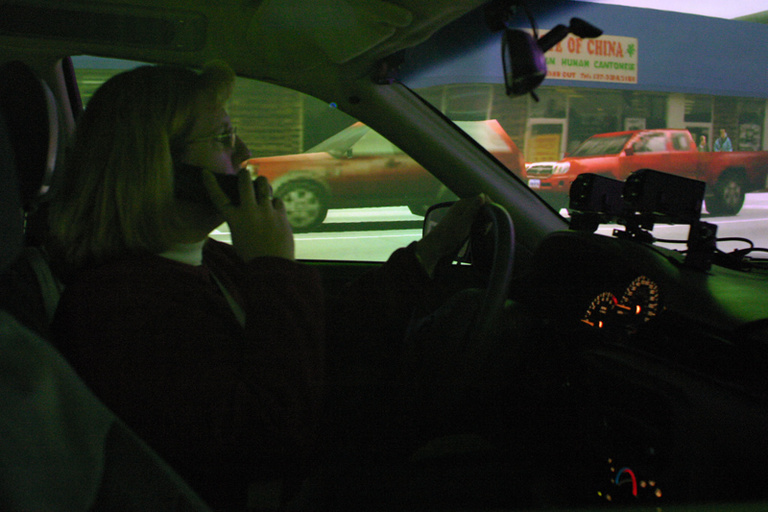
Female driver talking on phone in driving simulator
A new study will help researchers better differentiate between types of impaired driving behaviors. Photo provided by National Advanced Driving Simulator.

Susan Chrysler, director of research at NADS and chair of the Transportation Research Board’s Committee on Vehicle User Characteristics, believes that this type of technology has the potential to reduce the number of fatalities.

Since 2007, NADS, a research unit within the UI’s College of Engineering, has been actively exploring the application of vehicle-based sensors for detecting driver impairment due to alcohol, distraction, and drowsiness. The vehicle sensor data is becoming increasingly available on the vehicle communications network and provides a low-cost method of obtaining data to evaluate driver state.

Data that is now frequently available in the vehicle includes measures of steering wheel input, lane position, accelerator and brake pedal applications, speed, and headway. To date, the NADS team, along with John Lee, professor of industrial and systems engineering at the University of Wisconsin, has developed and tested separate algorithms that can successfully differentiate alcohol-impaired, drowsy, and distracted drivers from unimpaired drivers.

“Although the number of fatalities has declined over the last several years, too many people are still being killed in motor vehicle crashes," she says. "The ability to eliminate some of the major causes of crashes holds the hope that we can begin to significantly reduce the number of deaths and injuries."

NADS research studies rely on participation from local residents in Iowa City, Coralville, and surrounding communities. The general public is invited to participate in research studies conducted at NADS by signing up at www.drivingstudies.com or contacting NADS via email at recruit@nads-sc.uiowa.edu or calling 319-335-4719.

Contacts

Tim Brown, National Advanced Driving Simulator, 319-335-4785
Susan Chrysler, National Advanced Driving Simulator, 319-335-4306
Gary Galluzzo, University Communication and Marketing, 319-384-0009
Debug
Workflow
Workflow Status: 
Published
Workflow Notes: 
Moved the image from primary to in-line. Reviewed 10/17 AKM
Publication Schedule Notes: 
All, I have asked Tim Brown to submit a photo, if possible. Perhaps the story should run without a photo if he hasn't provided one by Thursday, Oct. 18. Gary Consulted with Gary and edited story and spiced up headline, breaking up some of the long graphs and adding links to college and NADS. - ljg Will see if we can get by-line of individual vs. NADS since story has quotes. ljg Received byline from Gary of Timothy Brown - ljg
Workflow Schedule Bridge: 
0
Send Workflow Email: 
0
Images
Primary Image Alt Text: 
A new study will help researchers better differentiate between types of impaired driving behaviors. Photo credit: National Advanced Driving Simulator.
Thumbnail: 
A new study will help researchers better differentiate between types of impaired driving behaviors. Photo credit: National Advanced Driving Simulator.
Thumbnail Alt Text: 
A new study will help researchers better differentiate between types of impaired driving behaviors. Photo credit: National Advanced Driving Simulator.
Home Page Feature Optional Image (Horizontal): 
Home Page Feature Optional Image (Vertical): 
Home Page Feature Optional Image Caption: 
A new study will help researchers better differentiate between types of impaired driving behaviors. Photo credit: National Advanced Driving Simulator.
Home Page Feature Optional Image Alt Text: 
A new study will help researchers better differentiate between types of impaired driving behaviors. Photo credit: National Advanced Driving Simulator.
Contact Wrapper
Contacts: 
Tim Brown
Contact1 Department: 
National Advanced Driving Simulator, 
Contact1 Phone: 
319-335-4785
Contact1 Email: 
timothy-l-brown@uiowa.edu
Contact2 Name: 
Susan Chrysler
Contact2 Department: 
National Advanced Driving Simulator, 
Contact2 Phone: 
319-335-4306
Contact2 Email: 
susan-chrysler@uiowa.edu
Contact3 Name: 
Gary Galluzzo
Contact3 Department: 
University Communication and Marketing, 
Contact3 Phone: 
319-384-0009
Contact3 Email: 
gary-galluzzo@uiowa.edu
Home Page and Section
Publish as Home Page Feature: 
0
Preview as Home Page Feature: 
0
Optional Home Page Feature Teaser: 
The University of Iowa National Advanced Driving Simulator recently received a new $650,000 research contract from the National Highway Traffic Safety Administration to research ways of detecting drowsy, distracted, and alcohol-impaired driving.
Publish as Home Page Picker Item: 
0
Preview as Home Page Picker Item: 
0
Home Page Picker - Short Title: 
National Advanced Driving Simulator awar
Publish: Arts Section Feature: 
0
Publish: Athletics Section Feature: 
0
Publish: Campus Section Feature: 
0
Publish: Community Section Feature: 
0
Publish: Health Section Feature: 
0
Publish: Research Section Feature: 
0
Preview: Arts Section Feature: 
0
Preview: Athletics Section Feature: 
0
Preview: Campus Section Feature: 
0
Preview: Health Section Feature: 
0
Preview: Community Section Feature: 
0
Preview: Research Section Feature: 
0
Publish Section Feature Date Stamp: Research: 
Wednesday, December 31, 1969 - 6:01pm
Publish Section Date Stamp: Outreach: 
Wednesday, December 31, 1969 - 6:01pm
Publish Section Feature Date Stamp: Health: 
Wednesday, December 31, 1969 - 6:01pm
Publish Section Feature Date Stamp: Arts: 
Wednesday, December 31, 1969 - 6:01pm
Publish Section Feature Date Stamp: Campus: 
Wednesday, December 31, 1969 - 6:01pm
Publish Section Feature Date Stamp: Athletics: 
Wednesday, December 31, 1969 - 6:01pm
Preview Section Feature Date Stamp: Research: 
Wednesday, December 31, 1969 - 6:01pm
Publish Home Page Feature Date Stamp: 
Wednesday, December 31, 1969 - 6:01pm
Preview Home Page Feature Date Stamp: 
Wednesday, December 31, 1969 - 6:01pm
Preview Section Feature Date Stamp: Athletics: 
Wednesday, December 31, 1969 - 6:01pm
Preview Section Feature Date Stamp: Campus: 
Wednesday, December 31, 1969 - 6:01pm
Preview Section Feature Date Stamp: Health: 
Wednesday, December 31, 1969 - 6:01pm
Preview Section Feature Date Stamp: Outreach: 
Wednesday, December 31, 1969 - 6:01pm
Preview Section Feature Date Stamp: Arts: 
Wednesday, December 31, 1969 - 6:01pm
Preview Home Page Picker Date Stamp: 
Wednesday, December 31, 1969 - 6:01pm
Publish Home Page Picker Date Stamp: 
Wednesday, December 31, 1969 - 6:01pm
Hidden Fields
Hidden Beat Email Sent: 
0
Hidden Mail Sent: 
0
Hidden Video FIDs: 
Hidden Date First Published: 
Thursday, October 18, 2012 - 9:45am
Hidden Date First Published Set: 
1
hiddent title for display: 
Detecting drowsy, distracted drivers
Story Type Display Name: 
Story
Unpublish?: 
0

Share:

Email Button

 Email