The roots of human self-awareness

Latest News Bar

Latest flood news: Coralville Lake down to 700.34 feet | Dubuque Street partially reopened (More info)

The roots of human self-awareness

Main Page Content

New study points to a complex, diffuse patchwork of brain pathways
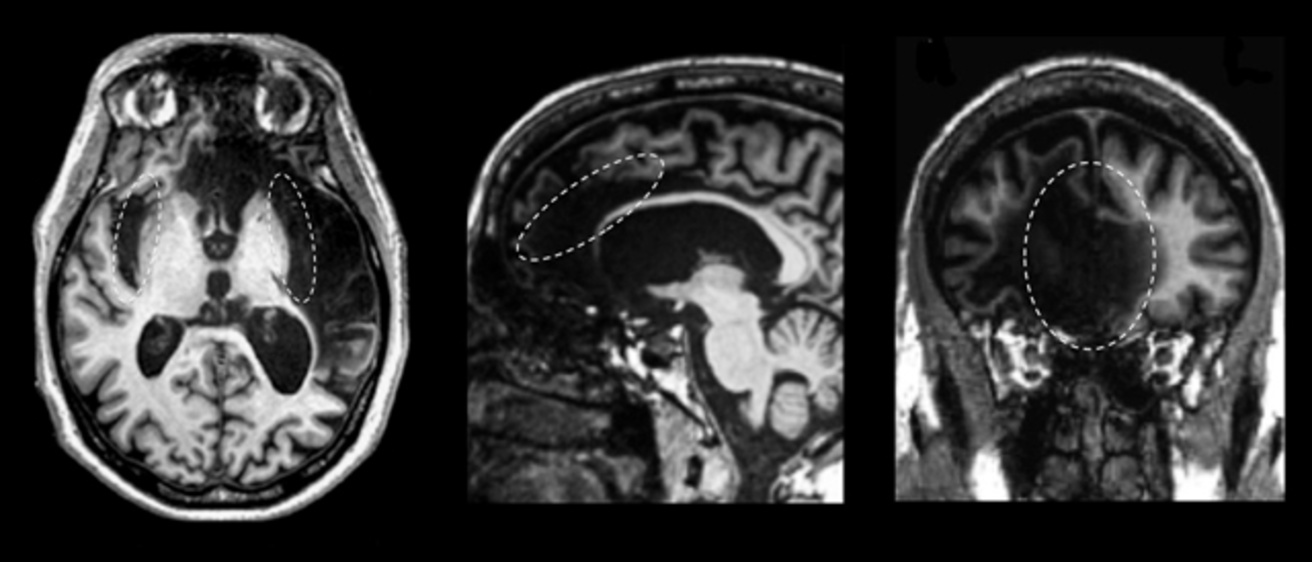
scans of the insular cortex, anterior cingulate cortex, and the medial prefrontal cortexUniversity of Iowa researchers studied the brain of a patient with damage to three regions long considered integral to self-awareness—left to right, the insular cortex, anterior cingulate cortex, and medial prefrontal cortex. The scans indicate that self-awareness is a product of a diffuse patchwork of brain pathways. Image credit: UI Department of Neurology.

Ancient Greek philosophers considered the ability to “know thyself” as the pinnacle of humanity. Now, thousands of years later, neuroscientists are trying to decipher precisely how the human brain constructs our sense of self.

Self-awareness is defined as being aware of oneself, including one's traits, feelings, and behaviors. Neuroscientists have believed that three brain regions are critical for self-awareness: the insular cortex, the anterior cingulate cortex, and the medial prefrontal cortex.

However, a research team led by the University of Iowa has challenged this theory by showing that self-awareness is more a product of a diffuse patchwork of pathways in the brain—including other regions—rather than confined to specific areas.

Meet "Patient R"

The conclusions came from a rare opportunity to study a person with extensive brain damage to the three regions believed critical for self-awareness. The person, a 57-year-old, college-educated man known as “Patient R,” passed all standard tests of self-awareness. He also displayed repeated self-recognition, both when looking in the mirror and when identifying himself in unaltered photographs taken during all periods of his life.

“What this research clearly shows is that self-awareness corresponds to a brain process that cannot be localized to a single region of the brain,” says David Rudrauf, co-corresponding author of the paper, published online Aug. 22 in the journal PLoS One. “In all likelihood, self-awareness emerges from much more distributed interactions among networks of brain regions.”

The authors believe the brainstem, thalamus, and posteromedial cortices play roles in self-awareness, as has been theorized.

Introspection and agency

The researchers observed that Patient R’s behaviors and communication often reflected depth and self-insight. First author Carissa Philippi, who earned her doctorate in neuroscience at the UI in 2011, conducted a detailed self-awareness interview with Patient R and found he had a deep capacity for introspection, one of humans’ most evolved features of self-awareness.

“Most people who meet Patient R for the first time have no idea that anything is wrong with him. They see a normal-looking middle-aged man who walks, talks, listens, and acts no differently than the average person."
— David Rudrauf

“During the interview, I asked him how he would describe himself to somebody,” says Philippi, now a postdoctoral research scholar at the University of Wisconsin-Madison. “He said, ‘I am just a normal person with a bad memory.’”

Patient R also demonstrated self-agency, meaning the ability to perceive that an action is the consequence of one’s own intention. When rating himself on personality measures collected over the course of a year, Patient R showed a stable ability to think about and perceive himself. However, his brain damage also affected his temporal lobes, causing severe amnesia that has disrupted his ability to update new memories into his “autobiographical self.” Beyond this disruption, all other features of R’s self-awareness remained fundamentally intact.

“Most people who meet R for the first time have no idea that anything is wrong with him,” notes Rudrauf, a former assistant professor of neurology at the UI and now a research scientist at the INSERM Laboratory of Functional Imaging in France. “They see a normal-looking middle-aged man who walks, talks, listens, and acts no differently than the average person.

“According to previous research, this man should be a zombie,” he adds. “But as we have shown, he is certainly not one. Once you’ve had the chance to meet him, you immediately recognize that he is self-aware.”

Unique pool of patients

Patient R is a member of the UI's world-renowned Iowa Neurological Patient Registry, which was established in 1982 and has more than 500 active members with various forms of damage to one or more regions in the brain.

The researchers had begun questioning the insular cortex’s role in self-awareness in a 2009 study that showed that Patient R was able to feel his own heartbeat, a process termed “interoceptive awareness.”

The UI researchers estimate that Patient R has ten percent of tissue remaining in his insula and one percent of tissue remaining in his anterior cingulate cortex. Some had seized upon the presence of tissue to question whether those regions were in fact being used for self-awareness. But neuroimaging results presented in the current study reveal that Patient R's remaining tissue is highly abnormal and largely disconnected from the rest of the brain.

“Here, we have a patient who is missing all the areas in the brain that are typically thought to be needed for self-awareness yet he remains self-aware,” says co-corresponding author Justin Feinstein, who earned his doctorate at the UI in February. "Clearly, neuroscience is only beginning to understand how the human brain can generate a phenomenon as complex as self-awareness."

The research team included Daniel Tranel, UI professor of neurology and psychology and director of the Neuroscience Graduate Program; Gregory Landini, UI professor of philosophy; Antonio Damasio, professor of neuroscience at the University of Southern California; Sahib Khalsa, co-chief resident of psychiatry at the University of California Los Angeles; and Kenneth Williford, associate professor of philosophy and humanities at the University of Texas at Arlington.

The National Institute of Neurological Disorders and Stroke, the National Institute on Drug Abuse, the Mathers Foundation, and the UI Carver College of Medicine funded the research.

Contacts

Justin Feinstein, Neurology
David Rudrauf, Neurology
John Riehl, Graduate College, 319-384-1309
Debug
Workflow
Workflow Status: 
Published
Workflow Notes: 
Publication Schedule Notes: 
Story is embargoed until 4 p.m. CST on Aug. 22.
Workflow Schedule Bridge: 
1
Send Workflow Email: 
0
Images
Primary Image Caption: 
University of Iowa researchers studied the brain of a patient with damage to three regions long considered integral to self-awareness—left to right, the insular cortex, anterior cingulate cortex, and medial prefrontal cortex. The scans indicate that self-awareness is a product of a diffuse patchwork of brain pathways. Image credit: UI Department of Neurology.
Primary Image Alt Text: 
scans of the insular cortex, anterior cingulate cortex, and the medial prefrontal cortex
Thumbnail: 
scans of the insular cortex, anterior cingulate cortex, and the medial prefrontal cortex
Thumbnail Alt Text: 
scans of the insular cortex, anterior cingulate cortex, and the medial prefrontal cortex
Home Page Feature Optional Image (Horizontal): 
Home Page Feature Optional Image (Vertical): 
Home Page Feature Optional Image Caption: 
University of Iowa researchers studied the brain of a patient with damage to three regions long considered integral to self-awareness—left to right, the insular cortex, anterior cingulate cortex, and medial prefrontal cortex). The scans indicate that self-awareness is a product of a diffuse patchwork of brain pathways. Image credit: UI Department of Neurology.
Home Page Feature Optional Image Alt Text: 
scans of the insular cortex, anterior cingulate cortex, and the medial prefrontal cortex
Contact Wrapper
Contacts: 
Justin Feinstein
Contact1 Department: 
Neurology, 
Contact1 Email: 
justin-feinstein@uiowa.edu
Contact2 Name: 
David Rudrauf
Contact2 Department: 
Neurology, 
Contact2 Email: 
david-rudrauf@uiowa.edu
Contact3 Name: 
John Riehl
Contact3 Department: 
Graduate College, 
Contact3 Phone: 
319-384-1309
Contact3 Email: 
john-riehl@uiowa.edu
Home Page and Section
Publish as Home Page Feature: 
1
Preview as Home Page Feature: 
0
Home Page Feature - Category for Display: 
Research
Optional Home Page Feature Teaser: 
A research team led by the University of Iowa has upended current thinking about areas in the human brain responsible for self-awareness. Pointing to the example of a rare patient with damage to areas long considered vital to the phenomenon, the researchers propose that self-awareness stems from a diffuse patchwork of pathways in the brain, rather than specific areas.
Publish as Home Page Picker Item: 
1
Preview as Home Page Picker Item: 
0
Home Page Picker - Category for Display: 
Research
Home Page Picker - Short Title: 
Roots of self-awareness
Home Page Picker Teaser: 
New study points to complex patchwork of brain pathways
Publish: Arts Section Feature: 
0
Publish: Athletics Section Feature: 
0
Publish: Campus Section Feature: 
0
Publish: Community Section Feature: 
0
Publish: Health Section Feature: 
0
Publish: Research Section Feature: 
1
Preview: Arts Section Feature: 
0
Preview: Athletics Section Feature: 
0
Preview: Campus Section Feature: 
0
Preview: Health Section Feature: 
0
Preview: Community Section Feature: 
0
Preview: Research Section Feature: 
0
Publish Section Feature Date Stamp: Research: 
Thursday, August 23, 2012 - 8:52am
Publish Section Date Stamp: Outreach: 
Wednesday, December 31, 1969 - 6:01pm
Publish Section Feature Date Stamp: Health: 
Wednesday, December 31, 1969 - 6:01pm
Publish Section Feature Date Stamp: Arts: 
Wednesday, December 31, 1969 - 6:01pm
Publish Section Feature Date Stamp: Campus: 
Wednesday, December 31, 1969 - 6:01pm
Publish Section Feature Date Stamp: Athletics: 
Wednesday, December 31, 1969 - 6:01pm
Preview Section Feature Date Stamp: Research: 
Wednesday, December 31, 1969 - 6:01pm
Publish Home Page Feature Date Stamp: 
Thursday, August 23, 2012 - 8:49am
Preview Home Page Feature Date Stamp: 
Wednesday, December 31, 1969 - 6:01pm
Preview Section Feature Date Stamp: Athletics: 
Wednesday, December 31, 1969 - 6:01pm
Preview Section Feature Date Stamp: Campus: 
Wednesday, December 31, 1969 - 6:01pm
Preview Section Feature Date Stamp: Health: 
Wednesday, December 31, 1969 - 6:01pm
Preview Section Feature Date Stamp: Outreach: 
Wednesday, December 31, 1969 - 6:01pm
Preview Section Feature Date Stamp: Arts: 
Wednesday, December 31, 1969 - 6:01pm
Preview Home Page Picker Date Stamp: 
Wednesday, December 31, 1969 - 6:01pm
Publish Home Page Picker Date Stamp: 
Friday, August 24, 2012 - 11:39am
Hidden Fields
Hidden Beat Email Sent: 
0
Hidden Mail Sent: 
0
Hidden Video FIDs: 
Hidden Date First Published: 
Wednesday, August 22, 2012 - 4:02pm
Hidden Date First Published Set: 
1
hiddent title for display: 
The roots of human self-awareness
Story Type Display Name: 
Story
Unpublish?: 
0

Share:

Email Button

 Email