A new heart 'map' for child patients

Latest News Bar

Latest flood news: Coralville Lake down to 700.34 feet | Dubuque Street partially reopened (More info)

A new heart 'map' for child patients

Main Page Content

Researchers at University of Iowa Children’s Hospital are studying a radiation-free procedure to make three-dimensional “maps” of electrical signals in children’s hearts, a move that could help cardiologists correct their rapid heart rhythms more directly.

The study, the first of its kind in the country relating to pediatric patients, will be presented at the American Heart Association’s Basic Cardiovascular Sciences 2012 Scientific Sessions July 23-26 in New Orleans, La.
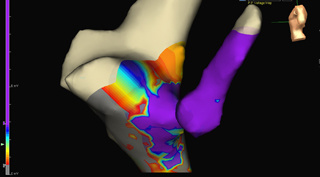
3D heart "maps" for children
UI researchers presented their latest findings on creating 3D heart "maps" for children at an American Heart Association meeting this week. The technique would allow cardiologists to more rapidly identify and correct irregular heart rhythms in children. It's also radiation free. Image courtesy of Nicholas Von Bergen.

Patients with rapid heart rhythms, called atrioventricular nodal reentrant tachycardia (AVNRT), suffer from disruptions in the electrical system of the heart that cause sudden rapid heart rates. Cardiologists have successfully treated adult patients with AVNRT through cryoablation, in which the malfunctioning tissue that causes the condition is destroyed by freezing.

But the procedure can be difficult, because every patient has a different cardiac profile. Low-voltage mapping is used to create a profile of high- and low-voltage areas to guide where to correct the irregular rhythms. However, no research has been done on children until now.

Lindsey Malloy, a cardiology fellow and researcher at UI Children’s Hospital, said the new procedure could improve the success of correcting irregular heart rhythms—known as cardiac ablation—or reduce the number of ablations for each patient. The 3D mapping, done with a computer-guided catheter rather than a radiation-guided catheter, can better pinpoint the location of the rapid heart rhythms and allow doctors to address them more accurately.

The new procedure is “a little like an EKG of the heart,” says Nicholas Von Bergen, clinical assistant professor of pediatrics at UI Children’s Hospital and a co-author on the study. “What traditionally has been done is that catheters would attempt to ablate the abnormal heart rhythm using radiation to guide them, but now we’re able to use a computer-generated, three-dimensional ‘map’ that tells us where these arrhythmias happen to be.”

The UI team created 3D voltage maps of the right atrium (upper chamber of the heart) using electrical recordings from inside the heart. They also identified a bridge of lower-voltage signals surrounded by even lower voltage tissue, a “saddle” indicating the potential origin of the abnormal heart rhythm.

Twenty-nine patients between the ages of 7 and 20 were included in the study.

Physicians successfully performed guided cryoablation of the weak electrical pathway using the bridge identified by voltage mapping in every patient. In 25 of 29 patients, there was an adequate lower-voltage saddle for guided ablation, and cardiologists successfully located the ablation site within the first three lesions in 15 out of 25 patients.

In procedures using radiation-guided ablation, patients would often receive several lesions as doctors searched for the arrhythmia. With the radiation-free procedure, doctors are able to more closely pinpoint the location and reduce the number of lesions.

“This use of voltage-guided mapping of this low saddle in AVNRT appears to be both safe and very effective in children while providing for more precise, electrically guided ablation,” Malloy says.

Ian Law, from UI Children’s Hospital, also took part in the study.

Contacts

Molly Rossiter, UI Health Care Marketing & Communications, 319-356-7127
Debug
Workflow
Workflow Status: 
Published
Workflow Notes: 
home page sidebar
Publication Schedule Notes: 
embargoed until 4 p.m., Monday, July 23; part of Tuesday, July 24 email
Workflow Schedule Bridge: 
0
Send Workflow Email: 
0
Images
Thumbnail: 
3D heart map for children
Thumbnail Alt Text: 
3D heart map for children
Home Page Feature Optional Image (Horizontal): 
Home Page Feature Optional Image (Vertical): 
Contact Wrapper
Contacts: 
Molly Rossiter
Contact1 Department: 
UI Health Care Marketing & Communications, 
Contact1 Phone: 
319-356-7127
Contact1 Email: 
molly-rossiter@uiowa.edu
Home Page and Section
Publish as Home Page Feature: 
0
Preview as Home Page Feature: 
0
Optional Home Page Feature Teaser: 
UI researchers presented their latest findings on creating 3D heart "maps" for children at an American Heart Association meeting this week. The technique would allow cardiologists to more rapidly identify and correct irregular heart rhythms in children. It's also radiation free.
Publish as Home Page Picker Item: 
1
Preview as Home Page Picker Item: 
0
Home Page Picker - Category for Display: 
Health
Home Page Picker - Short Title: 
A new heart 'map' for child patients
Home Page Picker Teaser: 
Researchers discuss 3D children's heart models
Publish: Arts Section Feature: 
0
Publish: Athletics Section Feature: 
0
Publish: Campus Section Feature: 
0
Publish: Community Section Feature: 
0
Publish: Health Section Feature: 
1
Publish: Research Section Feature: 
0
Preview: Arts Section Feature: 
0
Preview: Athletics Section Feature: 
0
Preview: Campus Section Feature: 
0
Preview: Health Section Feature: 
0
Preview: Community Section Feature: 
0
Preview: Research Section Feature: 
0
Publish Section Feature Date Stamp: Research: 
Wednesday, December 31, 1969 - 6:01pm
Publish Section Date Stamp: Outreach: 
Wednesday, December 31, 1969 - 6:01pm
Publish Section Feature Date Stamp: Health: 
Tuesday, July 24, 2012 - 9:53am
Publish Section Feature Date Stamp: Arts: 
Wednesday, December 31, 1969 - 6:01pm
Publish Section Feature Date Stamp: Campus: 
Wednesday, December 31, 1969 - 6:01pm
Publish Section Feature Date Stamp: Athletics: 
Wednesday, December 31, 1969 - 6:01pm
Preview Section Feature Date Stamp: Research: 
Wednesday, December 31, 1969 - 6:01pm
Publish Home Page Feature Date Stamp: 
Wednesday, December 31, 1969 - 6:01pm
Preview Home Page Feature Date Stamp: 
Wednesday, December 31, 1969 - 6:01pm
Preview Section Feature Date Stamp: Athletics: 
Wednesday, December 31, 1969 - 6:01pm
Preview Section Feature Date Stamp: Campus: 
Wednesday, December 31, 1969 - 6:01pm
Preview Section Feature Date Stamp: Health: 
Wednesday, December 31, 1969 - 6:01pm
Preview Section Feature Date Stamp: Outreach: 
Wednesday, December 31, 1969 - 6:01pm
Preview Section Feature Date Stamp: Arts: 
Wednesday, December 31, 1969 - 6:01pm
Preview Home Page Picker Date Stamp: 
Wednesday, December 31, 1969 - 6:01pm
Publish Home Page Picker Date Stamp: 
Tuesday, July 24, 2012 - 9:53am
Hidden Fields
Hidden Mail Sent: 
0
Hidden Video FIDs: 
Hidden Date First Published: 
Tuesday, July 24, 2012 - 9:51am
Hidden Date First Published Set: 
1
hiddent title for display: 
A new heart 'map' for child patients
Story Type Display Name: 
Story
Unpublish?: 
0

Share:

Email Button

 Email